The Space Between: How Modern Luxury Homes Erased Their Most Human Moments
There is a particular kind of disorientation that settles over a guest the moment they step from a Manhattan sidewalk directly into a loft's main living area, or cross a California compound's threshold only to find themselves immediately absorbed into an open kitchen and great room. The effect is seamless, certainly. It is also, in ways that are only beginning to be articulated by designers and behavioral researchers alike, quietly destabilizing.
The transitional space — the mudroom, the vestibule, the entry corridor, the anteroom — was never a glamorous architectural proposition. For decades, it was among the first casualties of the minimalist turn in high-end residential design. Floor plans were opened. Walls were removed. Thresholds were flattened into mere suggestions. What remained was a kind of spatial honesty that felt, for a time, like the ultimate expression of luxury: nothing hidden, nothing buffered, nothing withheld.
What was lost, however, was something considerably more difficult to quantify.
The Psychology of Passage
Architects and environmental psychologists have long understood that the human brain does not simply arrive somewhere. It transitions. The act of moving from the exterior world — with its noise, its social demands, its ambient stressors — into a private domestic environment is not instantaneous, no matter how quickly the body crosses a threshold. The mind requires a moment of decompression, a spatial signal that one context has ended and another has begun.
Traditional architecture accommodated this need almost unconsciously. The Georgian entry hall, the Craftsman mudroom, the formal foyer of the mid-century American estate — each served as a kind of psychological airlock. They slowed movement, invited a pause, and created a brief interval of neutral ground between the public self and the private one.
When those spaces disappeared from luxury design, the transition did not disappear with them. It simply went unaddressed.
"We ask so much of our front doors," says one Los Angeles-based architect whose practice focuses on bespoke residential projects. "They're expected to do in a single swing what an entire sequence of spaces used to accomplish. That's an enormous amount of psychological work for one moment to carry."
The Cost of Immediacy
The consequences of this architectural compression are subtle but persistent. Homeowners in highly open-plan residences frequently report a vague difficulty in fully relaxing, a sense that the home never quite feels like a refuge despite its appointments and scale. Interior designers working with high-net-worth clients in cities like New York, Chicago, and San Francisco describe a recurring complaint: the home is beautiful, the home is efficient, and yet something feels unresolved.
In many cases, that unresolved quality traces back not to the furnishings or the finishes, but to the absence of spatial sequence. When a person moves directly from the front door into the primary living space, the brain is asked to perform an abrupt contextual shift — from public alertness to private ease — with no architectural support. Over time, that daily demand accumulates.
The effect is compounded in households where professional and domestic life increasingly overlap. For many luxury homeowners, the home is simultaneously a workspace, an entertainment venue, and a sanctuary. Without transitional architecture to enforce boundaries, those roles bleed into one another in ways that erode the distinct character of each.
The Corridor as Ceremony
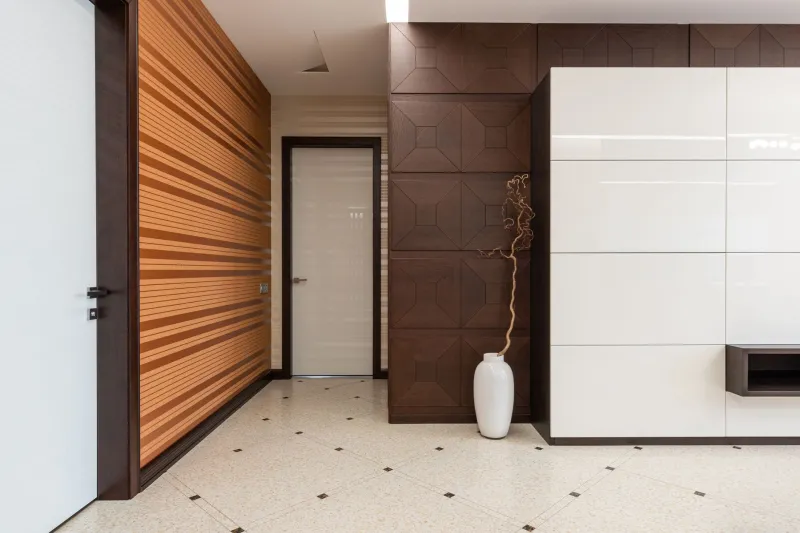
Forward-thinking architects are now reintroducing transitional space not as a concession to practicality, but as a deliberate design philosophy. The approach is rarely a return to the formal foyer of previous eras. Instead, it manifests as a series of subtle architectural gestures: a compressed entry gallery that expands into the main living area, a material shift underfoot that signals a change in zone, a lowered ceiling plane at the threshold that rises dramatically as one moves deeper into the home.
"The transition doesn't have to be large," notes a New York-based interior architect who recently completed a penthouse project on Manhattan's Upper West Side. "Even four or five feet of intentional space — a moment where you set something down, where the light changes, where you feel the room shift around you — can completely alter how a resident experiences the rest of their home."
In some projects, the transitional element is purely sensory rather than spatial. A change in flooring material from stone to wide-plank oak. A wall of textured plaster that interrupts the visual continuity of an open plan. A skylight positioned to cast a particular quality of light at the entry point alone. These interventions do not add square footage, but they restore the psychological function that square footage alone cannot provide.
Redefining the Arrival
For luxury homeowners undertaking new construction or significant renovation, the reintroduction of transitional space represents an opportunity to reconsider what the home is fundamentally asked to do. A residence that costs several million dollars to build or acquire is, at its most essential, an instrument of quality of life. That quality is not measured solely in kitchen specifications or primary suite dimensions. It is measured, in no small part, by how the home makes its inhabitants feel as they move through it — and that experience begins before they have taken a single step inside the main living area.
The mudroom, long dismissed as suburban and utilitarian, is being reconceived in luxury contexts as a material-rich transition space: a room of hooks and stone benches and carefully considered lighting that performs the essential service of allowing a person to shed the day before they carry it further into the house. The vestibule is being revived not as a relic of formal entertaining culture, but as an architectural acknowledgment that arrival is a process, not an event.
Some designers are drawing on Japanese spatial philosophy — specifically the concept of ma, the meaningful interval between spaces — to articulate what Western minimalism discarded. The idea is not ornamentation or excess, but intentionality: the understanding that what happens between spaces shapes the experience of the spaces themselves.
The Architecture of Becoming
There is a certain irony in the fact that the luxury homes most celebrated for their restraint are often those least equipped to support the complex emotional lives of their inhabitants. Minimalism, at its most rigorous, optimizes for visual coherence. It does not always optimize for human experience.
The designers and architects now championing the return of transitional space are not arguing against the aesthetic principles that define contemporary luxury residential design. They are arguing, rather, that those principles must be held in tension with a deeper understanding of how people actually inhabit their homes — how they arrive, how they decompress, how they move between the competing demands of their daily lives.
A home that acknowledges the complexity of arrival is, ultimately, a more generous home. It does not ask its residents to simply appear in their own living rooms, already composed and already present. It offers them a moment — a threshold, a passage, a pause — in which to become themselves again.
That, perhaps more than any material or view or floor plan, is what a truly luxury home provides.