Seen and Unseen: The New Design Language of Privacy in Glass-Forward Luxury Homes
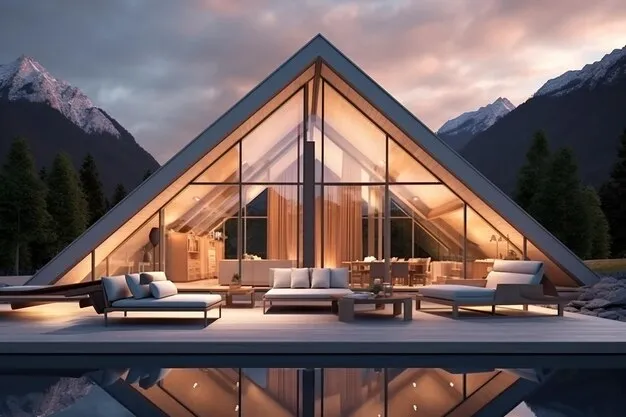
Photo: luxury glass house privacy modern architecture minimalist interior seclusion, via img.freepik.com
There is a particular irony embedded in the aspirations of the modern luxury homeowner. On one hand, they seek the visual drama of floor-to-ceiling glass walls, the seamless dissolution of interior and exterior, the sensation of living within the landscape rather than merely beside it. On the other, they desire sanctuary — genuine, uncompromised privacy that no amount of square footage alone can manufacture. For years, the design industry treated these desires as mutually exclusive. Today, the most accomplished architects in the country are proving they never had to be.
The homes emerging from studios in Los Angeles, the Hudson Valley, coastal Maine, and the mountain corridors of Colorado are redefining what it means to be both open and protected. They are residences that feel transparent without being exposed, expansive without being vulnerable. And the strategies behind them are more nuanced — and more technically sophisticated — than a simple frosted pane.
The Limits of Conventional Solutions
For much of the past two decades, the standard response to privacy concerns in glass-heavy homes was reactive rather than architectural. Motorized blinds were installed after the fact. Curtains — often incongruous with the minimalist aesthetic — were layered over carefully specified glazing. Privacy films were applied to windows in an afterthought of modesty. These interventions solved the immediate problem while undermining the design intent entirely.
"A curtain is not a privacy strategy," says one New York-based architect whose firm has completed more than a dozen glass-primary residences along the Eastern Seaboard. "It is a concession. And concessions, over time, erode the coherence of a home."
The concession model is giving way to something more considered: privacy as a first-principle design decision, integrated from the earliest stages of a project rather than addressed in its final weeks.
Orientation as the First Layer of Defense
Before any material selection or technology specification occurs, the most thoughtful architects are using site orientation to resolve privacy at the macro scale. A home positioned to face a preserved tree line, a body of water, or a carefully sculpted berm requires far fewer corrective interventions than one that faces a neighboring property or a public road.
In practice, this means conducting a rigorous analysis of sightlines — not just from the street, but from adjacent rooftops, elevated terrain, and even the flight paths of drones, which have become a genuine consideration in high-profile residential design. By rotating a structure's primary glass faces toward controlled views and away from external observation points, architects can preserve transparency without compromising discretion.
This orientation-first approach is increasingly paired with what designers call the "layered reveal" — a spatial progression from more public to more private zones that moves the occupant deeper into the home before exposing them to its most intimate spaces. Entry sequences are elongated. Transitional volumes, such as corridors, double-height landings, and gallery-like passages, create psychological distance between the world outside and the life within.
Intelligent Glazing: Privacy That Responds
When architecture alone cannot resolve every exposure challenge, technology steps in — though the most refined applications bear little resemblance to the crude privacy films of earlier generations. Electrochromic and polymer-dispersed liquid crystal (PDLC) glazing systems have matured considerably, offering glass that transitions from fully transparent to translucent at the touch of a panel, a voice command, or a programmed schedule.
In a Malibu residence completed in 2023, the entire ocean-facing wall of the primary bedroom suite is fitted with electrochromic glass that darkens incrementally as ambient light increases — providing solar control and visual privacy simultaneously without any mechanical intervention. The occupants experience the view when they choose it and seclusion when they need it, all without a single window treatment in sight.
PDLC systems, which scatter light in their opaque state to create a soft, luminous translucency rather than a flat white opacity, are finding particular favor in spaces where the aesthetic of the glass itself is valued even in its private mode. Bathrooms, dressing areas, and home office spaces benefit from the technology's ability to maintain the visual quality of the interior while eliminating any external view.
The cost of these systems remains substantial — integrated electrochromic glazing can add between $150 and $300 per square foot over standard high-performance glass — but among luxury buyers, the investment is increasingly regarded as fundamental rather than optional.
Spatial Layering and the Psychology of Enclosure
Not all privacy strategies are technological. Some of the most effective are purely spatial — manipulations of volume, materiality, and threshold that create the feeling of enclosure without any physical barrier.
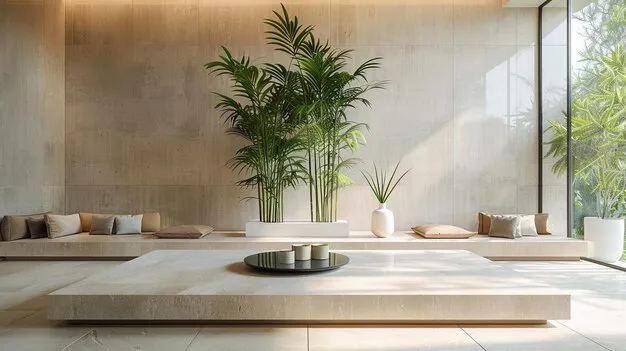
Double-height living spaces, for instance, can be made to feel more intimate through the strategic placement of a mezzanine or a dropped ceiling plane that compresses the volume at human scale. A seating area defined by a change in floor material — from polished concrete to warm oak, for example — reads as a distinct zone even without walls to delineate it. Landscape elements such as dense plantings, water features, and sculptural stone formations create visual interruption at the exterior without obscuring the broader view.
Architects working in this space speak frequently of the concept of "perceived enclosure" — the degree to which a person feels contained and protected regardless of whether physical barriers exist. Research in environmental psychology supports the intuition that humans are most comfortable in spaces where they can see without being seen, a condition the designer Christopher Alexander described decades ago as the "refuge-prospect" dynamic. The best glass-forward homes engineer this condition deliberately.
A New Definition of Openness
What the most compelling contemporary residences demonstrate is that openness and privacy are not opposing values but complementary ones — each made more meaningful by the presence of the other. A home that is entirely exposed offers no sense of arrival, no feeling of retreat. A home that is entirely enclosed offers no sense of connection to the world beyond its walls.
The luxury homeowners driving this evolution are not rejecting glass architecture. They are demanding that it mature — that it deliver not merely the appearance of a liberated, transparent life, but the genuine experience of one. That experience, it turns out, requires carefully considered moments of concealment just as much as it requires moments of revelation.
In this sense, the paradox resolves itself. Privacy does not diminish a glass-forward home. It completes it.