Orchestrating the Void: How Discerning Homeowners Are Bringing Sound to Life in Acoustically Naked Luxury Spaces
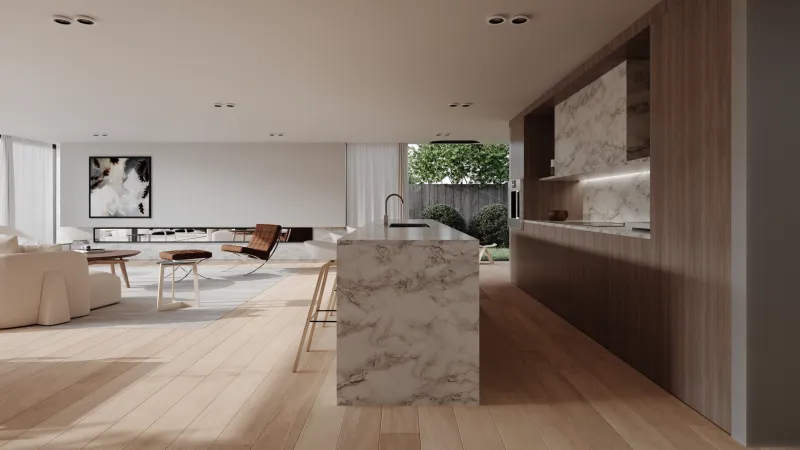
There is a particular kind of quiet that settles inside a newly completed minimalist home — one that initially reads as serenity and, over time, begins to feel like something else entirely. It is not the restorative silence of a mountain retreat or the contemplative hush of a private library. It is the silence of a room that has nothing to hold sound, nothing to soften it, nothing to give it a place to rest. And for the owners of some of America's most architecturally refined interiors, it has become one of the most persistently uncomfortable design problems they never anticipated.
The irony is precise: the very decisions that produce visual magnificence — the open floor plans, the stone and glass surfaces, the deliberate absence of soft furnishings — are the same decisions that strip a space of its acoustic character. What results is not peace, but a kind of sensory vacuum. Footsteps announce themselves with startling clarity. Voices carry and multiply. The refrigerator hums with the authority of a stage performer. And the instinctive remedy — adding more objects, more upholstery, more visual mass — runs directly counter to everything the home was designed to express.
This is the soundscape paradox of contemporary luxury living. And it is driving a quiet but consequential shift in how the most thoughtful homeowners approach the interiors they inhabit.
Why Minimalist Spaces Struggle Acoustically
The physics are straightforward, even if the design implications are not. Sound behaves predictably in the presence of hard, reflective surfaces: it bounces. Concrete floors, glass walls, lacquered cabinetry, and smooth stone countertops collectively create an environment in which sound waves travel freely, reflect repeatedly, and decay slowly. The technical term is reverberation — the persistence of sound after its source has ceased — and in residential settings, excessive reverberation produces that characteristic echo-chamber quality that makes open-plan luxury homes feel simultaneously grand and inhospitable.
Conventional interiors manage this problem almost accidentally. Upholstered sofas, area rugs, curtains, bookshelves filled with objects, and even the irregular surfaces of decorative accessories all function as acoustic absorbers, breaking up sound waves before they can accumulate into something disorienting. Strip those elements away in pursuit of a cleaner aesthetic, and the acoustic environment degrades in proportion.
What is less commonly discussed is the psychological dimension of this effect. Research in environmental psychology consistently links excessive reverberation and unpredictable ambient noise to elevated stress responses, reduced concentration, and a diminished sense of personal comfort. A home that looks like sanctuary may, in acoustic terms, be producing the opposite effect on its residents.
The Case Against Acoustic Compromise
For homeowners deeply committed to minimalist principles, the conventional acoustic solutions are non-starters. Foam panels and fabric wall treatments, however effective, introduce a visual language that belongs in a recording studio rather than a curated residential interior. Area rugs help, but only within the limited zone they occupy. And the suggestion to simply add more furniture is, for many, a philosophical concession they are unwilling to make.
The more interesting question — and the one that is beginning to attract serious design attention — is whether acoustic quality can be achieved through means that are either entirely invisible or so precisely integrated into the architecture that they become indistinguishable from it.
The answer, increasingly, is yes.
Hidden Architecture, Heard but Not Seen
A growing number of luxury residential projects are incorporating acoustic treatment directly into the building envelope, long before the first piece of furniture arrives. Perforated plaster ceilings with concealed absorptive backing, for instance, present a surface that reads as seamlessly architectural while performing meaningful sound absorption behind the scenes. Similar principles apply to certain millwork configurations, where the depth and internal geometry of built-in cabinetry can be engineered to diffuse rather than reflect sound without altering the cabinet's visible profile.
Flooring choices, too, are being reconsidered with acoustic performance as a primary criterion rather than an afterthought. Certain engineered hardwood systems now incorporate underlayment materials with measurable impact-noise reduction properties. Large-format stone tiles can be installed over acoustic membranes. Even the specification of particular concrete finishes — micro-topping applications rather than polished slabs — can modestly reduce surface reflectivity without any visible departure from the aesthetic.
The result is a home that manages its acoustic environment through the architecture itself, rather than through objects placed within it.
Sound as a Design Element
Beyond passive acoustic treatment, a more expressive approach is gaining traction among luxury homeowners: the deliberate introduction of sound as a designed experience, curated with the same intentionality applied to lighting or materiality.
Whole-home audio systems have existed for decades, but their integration into minimalist interiors has historically been clumsy — visible speakers, exposed wiring, and control interfaces that compete visually with the spaces they serve. The current generation of architectural audio technology has largely resolved these tensions. In-ceiling and in-wall speaker arrays, tuned to the specific acoustic properties of individual rooms, can deliver high-fidelity sound from sources that are entirely invisible to the eye. Some of the most sophisticated residential installations now incorporate individually addressable speaker zones, allowing different areas of an open-plan home to carry different sonic experiences simultaneously without bleeding into one another.
But the more nuanced development is not about music at all. It is about ambient sound design — the deliberate programming of acoustic environments that support specific moods, activities, or times of day without ever resolving into identifiable content. The soft movement of air, the distant suggestion of water, the barely perceptible texture of low-frequency tone: these are the tools of a discipline that sits somewhere between architecture, interior design, and composition. And in the hands of specialists who understand both acoustic physics and the particular demands of luxury residential spaces, they can transform the character of a room without altering a single visible element within it.
The Considered Soft Object
None of this entirely displaces the value of thoughtfully chosen soft furnishings. The distinction lies in intention. A single large-format rug, selected as much for its acoustic contribution as for its visual weight, performs double duty in a space that demands every element justify its presence. A linen curtain panel, hung not from necessity but from design conviction, absorbs high-frequency reflections while adding vertical warmth to a glass-dominated wall. A generously upholstered reading chair, positioned with architectural precision, anchors a corner and quiets it simultaneously.
The minimalist principle, properly understood, is not the elimination of all softness. It is the elimination of the unnecessary. When a soft element earns its place through acoustic function as much as through aesthetic contribution, it ceases to be clutter and becomes something closer to infrastructure.
Silence, Reconsidered
The most refined homes are not the loudest, nor are they the quietest. They are the ones in which sound — ambient, architectural, and designed — exists in a state of calibrated equilibrium with the space that contains it. Silence, in such a context, is not an absence but a presence: something shaped, maintained, and occasionally interrupted with purpose.
For homeowners willing to engage with their acoustic environment as seriously as they engage with their lighting plan or their material palette, the rewards are considerable. A space that sounds as deliberate as it looks does not merely impress — it sustains. It is the kind of home one returns to at the end of a long day not merely because it is beautiful, but because it feels, in the fullest sensory sense of the word, genuinely good to be inside.