The Invisible Kitchen: How Affluent Homeowners Are Designing Cooking Spaces That Disappear
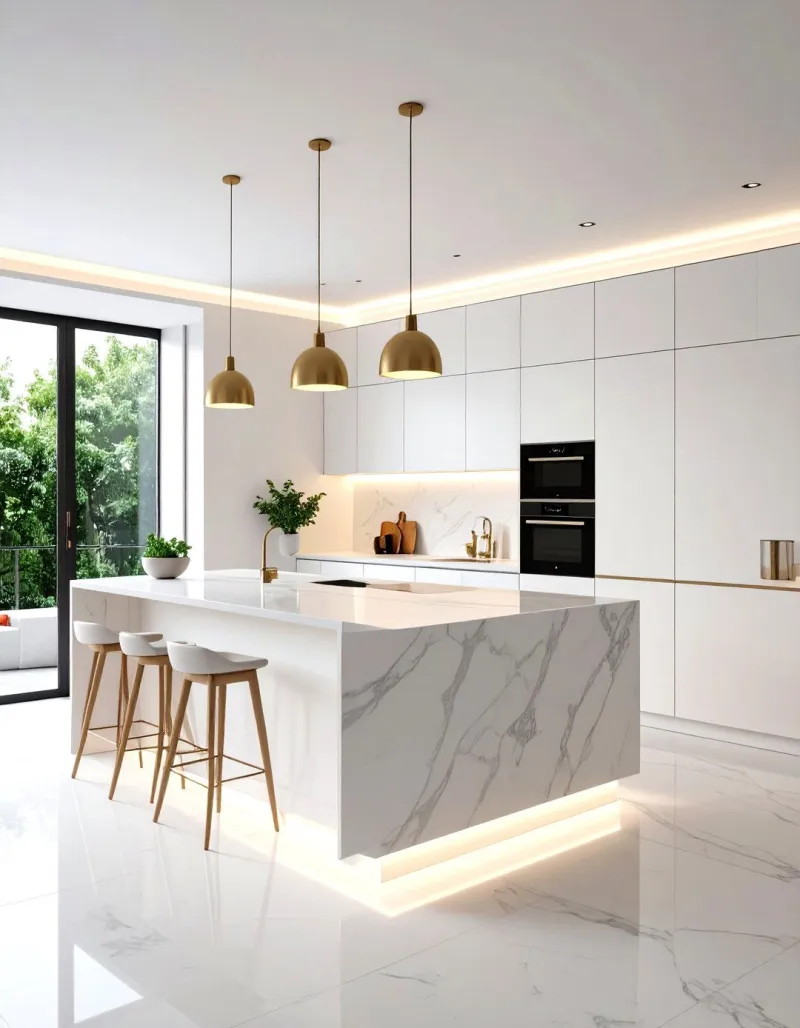
Photo: luxury minimalist kitchen integrated appliances hidden cabinetry seamless design, via images.welovehomeblog.com
For most of the past three decades, the luxury kitchen operated as a kind of performance stage. Gleaming commercial ranges anchored the room like sculpture. Refrigerators the size of armoires announced their presence in brushed stainless steel. Ventilation hoods, clad in custom metalwork or reclaimed timber, rose above the island as architectural centerpieces. The message was clear: this is a serious kitchen, and it will be seen.
That message is now being quietly — and deliberately — unsent.
Across the country's most design-forward residences, from the glass-walled hillside homes of Silicon Valley to the refined brownstone renovations of Manhattan's Upper West Side, a different philosophy is taking hold. The kitchen, in these spaces, does not announce itself. It does not compete for attention. It recedes into the surrounding architecture with such studied precision that a first-time visitor might not immediately recognize it as a kitchen at all.
This is the invisible kitchen — and it is rapidly becoming the defining interior aspiration of America's most discerning homeowners.
The Problem with the Showcase Kitchen
To understand why this shift is occurring, it helps to examine what the showcase kitchen was actually communicating — and to whom. The stainless steel aesthetic borrowed its authority from professional restaurant kitchens, signaling culinary seriousness and a kind of domestic ambition. It was, at its core, a status performance. The six-burner range told guests something about the homeowner's identity, their values, their lifestyle.
But status, in the highest echelons of American luxury, has been undergoing a quiet renegotiation. The conspicuous display of wealth — in fashion, in automobiles, and increasingly in interior design — has yielded ground to something more restrained. Quiet luxury, as it has come to be known in the broader cultural conversation, prizes understatement over declaration. It values the confidence of the person who has nothing to prove.
Applied to the kitchen, this philosophy produces a space that is entirely functional, impeccably equipped, and visually indistinguishable from the cabinetry surrounding it. The refrigerator wears the same panel as the cabinet to its left. The dishwasher has no visible controls. The range hood retracts into the ceiling or disappears behind a flush panel when not in operation. The result is not a lesser kitchen — it is, by almost every functional measure, a superior one. It is simply a kitchen that has learned to be quiet.
The Technology Making It Possible
The invisible kitchen is not merely an aesthetic preference — it is a product of genuine technological advancement. The appliance industry has invested significantly in panel-ready and fully integrated product lines that allow cabinetmakers and interior designers to clad refrigerators, dishwashers, freezer drawers, and even wine columns in custom millwork that matches the surrounding cabinetry to within millimeters.
Miele, Sub-Zero, Gaggenau, and Thermador all offer extensive integrated lines, and the category has expanded substantially over the past five years as consumer demand has grown. Induction cooking surfaces, once considered a compromise by serious cooks, have achieved a level of performance that rivals gas in most residential applications — and their flush, featureless appearance makes them ideal for the invisible aesthetic. Some of the most refined installations use surfaces that double as countertop space when the cooktop is not in use, the cooking zone identifiable only by a subtle embossed grid in the stone.
Ventilation, historically the most architecturally disruptive element of any kitchen, has seen particular innovation. Downdraft systems integrated into the cooktop surface eliminate the need for an overhead hood entirely. Ceiling-integrated ventilation — distributed across a broader area rather than concentrated in a single fixture — captures cooking effluent without any visible mechanical intrusion. In certain high-specification projects, the entire ventilation system is housed within a custom millwork volume that reads, from the dining area, as nothing more than a tall cabinet.
The Cost of Disappearing
None of this comes without a significant financial commitment. Fully integrated appliance packages for a primary kitchen in a luxury residence routinely begin at $80,000 and can exceed $200,000 for larger spaces with comprehensive wine storage, multiple refrigeration zones, and steam or speed-cooking capabilities. Custom cabinetry — the essential partner to any integrated appliance strategy — adds further cost, with high-end millwork firms in major markets charging between $1,500 and $4,000 per linear foot for bespoke work of this caliber.
The storage architecture required to sustain the invisible aesthetic also demands investment. Every appliance that disappears must be housed somewhere; every countertop cleared of small appliances must offer an alternative location for the coffee maker, the blender, and the stand mixer. The solution, in sophisticated projects, is a dedicated appliance garage — a cabinetry volume with lift-up or sliding doors that conceals small appliances at counter height, allowing them to be used without being displayed. When the doors close, the counter returns to its pristine, unencumbered state.
For buyers who understand the long-term implications, the investment calculates favorably. Kitchens that integrate seamlessly with the surrounding living environment tend to age more gracefully than those built around a specific appliance aesthetic — a stainless steel kitchen that felt current in 2012 may feel dated today, while a panel-ready, millwork-driven kitchen remains relevant across design cycles.
Living With Less on Display
Beyond the financial and aesthetic dimensions, the invisible kitchen reflects a genuine shift in how affluent homeowners relate to their domestic environments. The kitchen, in the open-plan layouts that characterize contemporary luxury homes, is no longer a separate room. It shares visual and spatial territory with the living area, the dining room, and increasingly the outdoor entertaining space. In that context, a kitchen that asserts its identity too forcefully disrupts the coherence of the whole.
"The kitchen used to be the hero," notes one Los Angeles-based interior designer whose practice focuses exclusively on high-end residential projects. "Now it is part of an ensemble. The best kitchens today are the ones you stop noticing — because they are so well integrated that they simply become part of the room."
This is, ultimately, the ambition of the invisible kitchen: not to diminish the cooking space, but to liberate the home from its dominance. When the kitchen disappears into the architecture, the architecture — and the life lived within it — can finally take center stage.