When the View Becomes the Room: How Curated Interiors Are Outpacing the Panorama
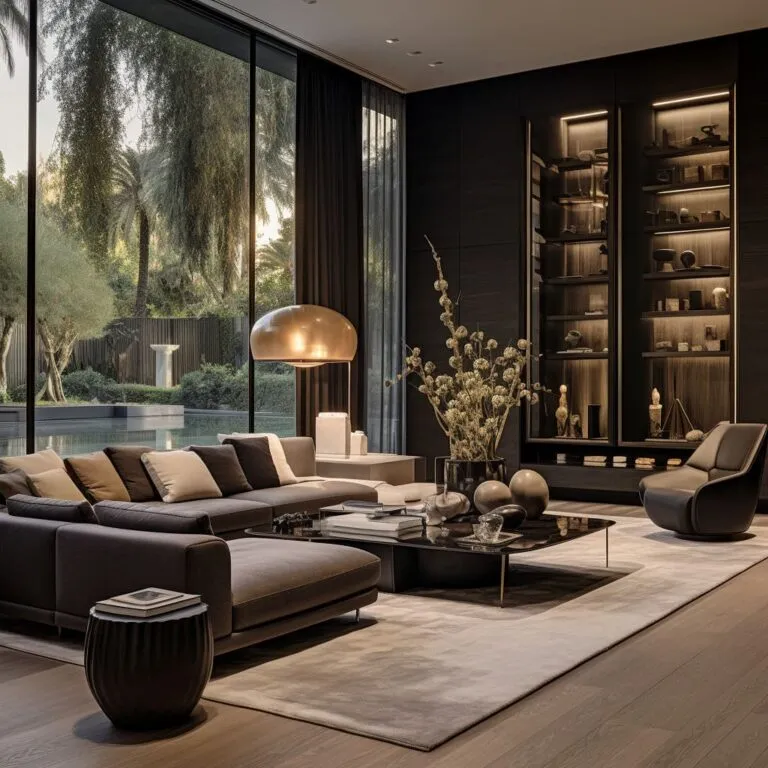
Photo: minimalist luxury interior design curated living space modern architecture no windows, via fancyhouse-design.com
For decades, the American luxury real estate market operated on a near-universal assumption: the grander the view, the greater the value. Oceanfront sight lines, mountain panoramas, and urban skylines served as the definitive currency of premium property. A floor-to-ceiling window overlooking the Pacific or a wraparound terrace commanding the Manhattan grid was not merely an amenity — it was the listing's entire argument.
That argument is losing ground.
Across the country's most discerning markets — from the hillside estates of Bel-Air to the quiet compounds of the Hamptons and the glass-wrapped penthouses of Chicago's Gold Coast — a quieter design philosophy is gaining traction. Wealthy homeowners and the architects they commission are increasingly choosing to look inward, cultivating interior environments so precisely composed that the outside world becomes, at best, a secondary consideration.
This is not a rejection of beauty. It is, in fact, a more demanding pursuit of it.
The Controlled Landscape
The concept of the curated interior landscape operates on a principle that seasoned designers have long understood but rarely articulated for a general audience: an unmanaged view is a variable you cannot control. A Pacific sunset is magnificent, but it is also inconsistent, seasonally altered, and increasingly compromised by atmospheric haze, coastal development, and the simple reality that you cannot edit it.
A designed interior, by contrast, is entirely authored.
Architects working at the upper tier of the residential market describe a growing client preference for what might be called environmental sovereignty — the ability to determine, with precision, every visual and sensory input within a given space. This means selecting stone with the same deliberation one might apply to a painting, positioning a single sculptural object to anchor a room's entire compositional logic, and treating light not as something that enters a home but as something that is choreographed within it.
"There is a certain kind of client who has had the view," notes one New York-based architect whose practice focuses exclusively on high-net-worth residential projects. "They've lived in the apartment with the skyline. And what they want now is a space that performs — that holds its quality at two in the afternoon on a Tuesday in February, not just at sunset on a clear evening in October."
What the Market Is Beginning to Reflect
The financial implications of this shift are not yet uniformly captured in standard appraisal methodology, but they are becoming visible in transaction data and in the premiums buyers are willing to assign to properties that demonstrate design intentionality at the highest level.
In markets such as Aspen, Miami's Coconut Grove, and the Pacific Heights neighborhood of San Francisco, properties that might once have been considered disadvantaged by limited external views — a home set into a hillside, a residence oriented around a private courtyard, a penthouse whose windows face an interior light well rather than a recognizable skyline — are achieving prices that challenge conventional valuation logic.
The explanation, increasingly, lies in what those properties offer in place of the view: a complete, coherent interior world. Bespoke millwork that reads as architecture. Material selections — honed basalt, hand-applied plaster, brushed bronze — that reward sustained attention. Spatial proportions calibrated to produce a specific psychological effect. These are not decorative choices. They are investments in a different category of value, one that appreciates not with the real estate cycle but with the permanence of craft.
Real estate professionals who specialize in the ultra-high-net-worth segment report that buyer conversations have shifted accordingly. The question is no longer simply "What does it look out onto?" but rather "What does it feel like to be inside of it?"
The Aesthetics of Earned Privacy
There is also a cultural dimension to this trend that deserves consideration. In an era of radical visual saturation — where every destination is documented, every vista is accessible via a screen, and the concept of an exclusive view has been somewhat democratized by drone photography and digital rendering — the genuinely rare commodity is no longer the panorama. It is the private, undocumented, unreplicable interior.
Wealth aesthetics have always been calibrated to scarcity. When views were difficult to access, they commanded a premium. Now that they are ubiquitous in imagery if not in person, their psychological potency as status markers has diminished for a particular class of buyer — specifically, the buyer who has already had them.
What replaces them is something more intimate and, in a meaningful sense, more personal. A home whose value is entirely self-contained — whose quality is legible only to those who enter it — carries a kind of discretion that resonates with the current moment in American luxury culture. It does not announce itself. It reveals itself, slowly, to those who are present within it.
This is the same impulse that has driven the quiet luxury movement in fashion and hospitality: the preference for unmarked excellence over branded display. Applied to architecture and interior design, it produces spaces that are, paradoxically, both more private and more considered than their view-forward counterparts.
Designing the Interior View
For architects and interior designers navigating this sensibility, the practical challenge is significant. Designing a space that sustains attention without external scenery demands a level of compositional rigor that panoramic views conveniently excuse. When the window offers a spectacular distraction, the room can afford to be less resolved. When it does not, every surface, proportion, and material relationship must carry its weight.
The most successful examples of this approach share certain characteristics. They treat natural light as a material in its own right — not simply admitted but directed, diffused, and modulated through skylights, light wells, and carefully positioned apertures that create movement and depth across interior surfaces throughout the day. They employ a restrained material palette executed with exceptional craft, allowing texture and patina to provide the visual complexity that a view might otherwise supply. And they attend with particular care to spatial sequence — the experience of moving through a home, of compression and release, of threshold and arrival.
The result, in the finest examples, is a home that functions as its own landscape. One that holds the eye, engages the senses, and sustains a quality of presence that no external panorama, however dramatic, can reliably deliver.
A Redefined Premium
The luxury real estate market has always been, at its core, a market for aspiration. What changes over time is the content of that aspiration — what the most sophisticated buyers are reaching toward, and what they have learned, through experience, to value.
The current trajectory suggests that the interior, authored with precision and executed with permanence, is emerging as the preeminent aspiration. Not the view beyond the glass, but the world composed within it.
For those who have spent years acquiring panoramas, this may read as a paradox. For those who have spent years inside them, it reads as a logical conclusion.