The Glass Cage: How the Promise of Openness Is Quietly Closing In on Luxury Homeowners
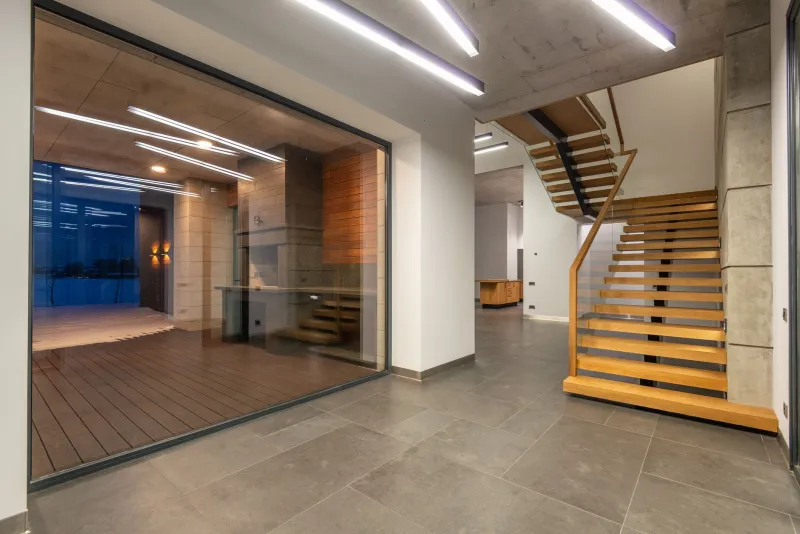
There is a particular moment that many owners of glass-forward homes describe with near-identical language. It arrives not during a dinner party or a busy weekend morning, but late at night — standing in a warmly lit room, surrounded by floor-to-ceiling glazing, staring into the darkened landscape beyond. The view, so luminous and commanding by day, has reversed. The glass has become a mirror. And for the first time, the homeowner realizes they are not looking out. They are on display.
This is the paradox at the heart of contemporary transparent architecture — a design philosophy that promised liberation and delivered, for a surprising number of its most devoted adherents, something far more complicated.
The Ideology of Glass
To understand how this paradox took hold, it helps to trace the ambitions that elevated glass architecture to its current cultural apex. The mid-century masters — Mies van der Rohe with his Farnsworth House, Philip Johnson with his Glass House in New Canaan, Connecticut — proposed transparency as a philosophical stance. To live behind glass was to reject the fortress mentality of traditional domestic architecture. It was an assertion of confidence, a declaration that the self had nothing to conceal and everything to inhabit.
For decades, that ideology translated seamlessly into aspiration. The luxury real estate market embraced glazed facades as the definitive signal of architectural sophistication. From the canyon-side residences of Los Angeles to the lakefront estates of the Pacific Northwest, maximum transparency became synonymous with maximum prestige.
What the ideology did not fully account for was the psychological reality of inhabiting that transparency — not as a visiting critic or a weekend guest, but as a permanent resident navigating the full spectrum of domestic life.
The Performance of Living
Dr. Miriam Holt, a licensed psychologist based in Chicago who specializes in environmental psychology and works with high-net-worth clients, has observed a pattern she describes as "architectural performance anxiety." The term captures something specific: the heightened self-consciousness that emerges when a home's design eliminates the visual boundaries between private behavior and potential observation.
"What I see repeatedly is a kind of low-grade hypervigilance," she explains. "These homeowners are not paranoid people. They are accomplished, self-possessed individuals. But something in the architecture activates a monitoring response — a persistent awareness of being potentially seen — that doesn't fully switch off. Over time, that sustained alertness is genuinely fatiguing."
The phenomenon is compounded by the social geography of modern American luxury real estate. Many glass-forward homes are positioned to maximize views — which, by definition, means positioning them within sight lines of neighboring properties, hiking trails, private roads, or, in urban contexts, adjacent towers. The same orientation that frames a spectacular panorama also frames the homeowner within it.
One San Francisco Bay Area resident, who purchased a glass-walled hillside home five years ago and asked not to be identified by name, described the adjustment with candor. "I spent two years gradually layering in window treatments I swore I'd never need. Sheers first, then heavier panels in the bedroom, then motorized shades in the living area. At a certain point I realized I was systematically undoing the thing I had paid for. The transparency had become untenable."
Isolation by Exposure
Perhaps the most counterintuitive finding to emerge from conversations with architects, psychologists, and homeowners is this: the very openness that glass architecture promises as connection — to nature, to light, to a sense of expansive belonging in the landscape — can produce its inverse. Sustained exposure, it turns out, does not always generate intimacy. It can generate withdrawal.
San Diego–based architect Rafael Mora, whose residential practice includes a number of significant glazed structures along the Southern California coast, has grown increasingly attentive to this dynamic. "There's a threshold," he says. "Below it, glass is genuinely liberating. It dissolves the boundary between the interior and the world, and that dissolution feels like abundance. But push past that threshold — more glass, less refuge — and something shifts. The home stops feeling like a sanctuary and starts feeling like a stage. And people don't relax on stages."
Mora now incorporates what he calls "opacity anchors" into his residential designs: deliberate zones of enclosure — a library with solid walls and a low ceiling, a study tucked behind a stone partition — that offer residents a psychological counterweight to the home's more transparent volumes. "People need somewhere to be unseen," he says simply. "That's not a failure of the glass aesthetic. It's a completion of it."
The Social Dimension
The isolation produced by glass living is not purely a matter of individual psychology. It operates at a social register as well. Several homeowners interviewed for this piece described a gradual contraction of their domestic social lives — not from any lack of desire for company, but from the sheer self-consciousness that entertaining in a fully transparent environment can provoke.
A couple who own a glass-walled weekend residence in the Hudson Valley noted that guests, however enthusiastic about the home's aesthetics, often gravitated toward the few interior spaces that offered some degree of enclosure. "Everyone would end up in the kitchen," the wife recalled. "Which has the most cabinetry and the least glass. It became a running joke. We had this spectacular living room with a wall of windows looking out over the valley, and people would stand in it for five minutes to admire the view and then drift back to the kitchen to actually talk."
This behavioral instinct — the retreat toward enclosure during moments of social intimacy — reflects something fundamental about human spatial psychology. Researchers in environmental behavior have long documented what is sometimes called the "prospect and refuge" dynamic: people seek open views for awareness and safety, but require enclosed spaces for genuine comfort and vulnerability. Glass architecture, at its most extreme, provides prospect in abundance while systematically eliminating refuge.
Designing Toward Wholeness
The most thoughtful voices within the architecture and design community are not arguing against glass. They are arguing for a more honest reckoning with what glass alone cannot provide.
"The conversation has matured," says New York–based interior designer Cassandra Reeves, whose residential portfolio spans the full spectrum from raw concrete lofts to glass-forward estates in Connecticut and Florida. "Early in my career, a client asking for more privacy in a glass home felt like a problem to solve around. Now I understand it as part of the brief. Transparency is a tool. It is not, by itself, a philosophy of wellbeing."
Reeves increasingly specifies materials and spatial configurations that create what she calls "graduated privacy" — an orchestrated sequence of zones ranging from fully open to fully enclosed, so that residents can modulate their relationship to visibility throughout the day and across different emotional registers. "The goal is a home that breathes," she says. "Open when you want to be open. Held when you need to be held."
It is a formulation that would not have surprised the Farnsworth House's most famous resident. Edith Farnsworth herself, after years of living in Mies van der Rohe's masterpiece, famously described the experience as oppressive — a fishbowl existence that offered her no psychological shelter. She eventually sold the property and moved on.
The lesson embedded in that history is not that glass is a mistake. It is that transparency, like all powerful architectural forces, demands to be handled with full awareness of its human consequences. The homes that will endure — and the lives lived most fully within them — will be those that treat openness not as an absolute, but as one element in a richer, more honest conversation about what it means to truly dwell.