The Eloquence of Less: Inside the Quiet Luxury Movement Reshaping America's Most Coveted Interiors
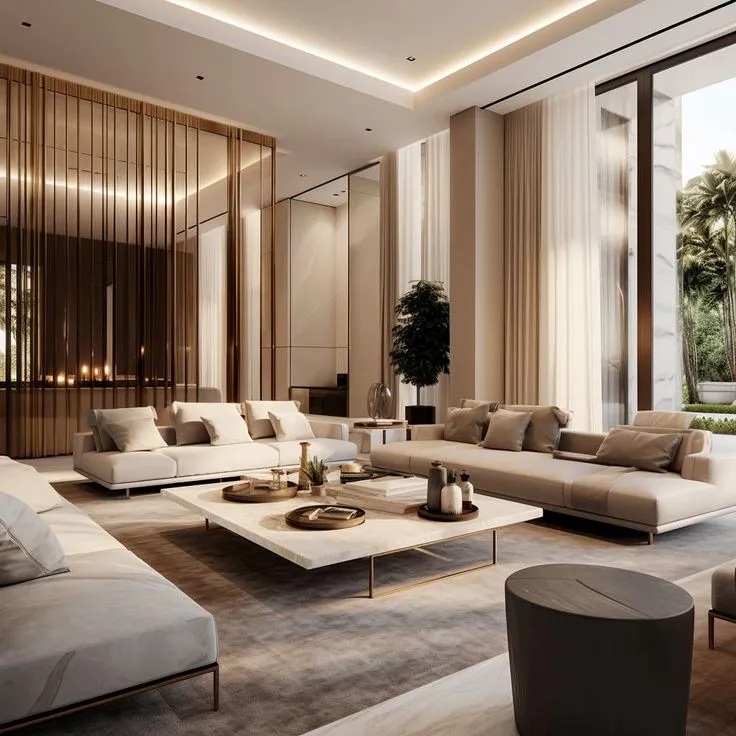
Photo: quiet luxury minimalist interior design neutral tones natural materials upscale living room, via i.pinimg.com
For the better part of two decades, American luxury interiors operated on a fairly consistent set of assumptions. More was demonstrably better. Surfaces rewarded embellishment. The finest rooms announced their cost with confidence, and the measure of a space was, in no small part, the cumulative weight of its contents.
That era is over — not with a dramatic reversal, but with the quiet, inevitable authority of something that was always true reasserting itself.
The movement known as quiet luxury has arrived in American homes with the same understated conviction it brings to everything else. Its adherents do not announce their aesthetic preferences. They simply live in rooms that feel different: lighter, calmer, more deliberate. Rooms that ask nothing of you except that you be present in them.
What Quiet Luxury Actually Means
The term itself has accumulated a certain cultural momentum over the past several years, migrating from fashion commentary — where it described the muted palette and impeccable construction of brands like The Row and Loro Piana — into the broader language of design and lifestyle. In the context of interiors, it carries a specific and demanding set of implications.
Quiet luxury is not minimalism in its most austere academic form. It is not the deliberate severity of a white room with a single object. It is, rather, a philosophy of curation: the conviction that every element in a space should earn its presence, that quality of material speaks more eloquently than quantity of object, and that the most sophisticated rooms are those in which nothing feels excessive and nothing feels absent.
"The clients who come to me asking for quiet luxury aren't asking for less," explains New York-based interior designer Sylvia Hartmann, whose portfolio includes residences in the Hamptons, Tribeca, and Aspen. "They're asking for more intentionality. They want to feel the difference between a room that was assembled and a room that was considered."
That distinction — between assembly and consideration — is perhaps the most useful lens through which to understand what separates quiet luxury from mere minimalism or, on the other end of the spectrum, from the maximalist interiors it is displacing.
The Cultural Shift Behind the Aesthetic
It would be a mistake to read quiet luxury purely as a design trend. Its emergence reflects something more fundamental about how a particular stratum of American life has begun to reorient its values.
The decades that produced maximalist interiors were also decades that celebrated visibility. Wealth, in that cultural moment, expressed itself through display. The home was, among other things, a stage — and its furnishings were the performance.
What has changed, in the estimation of many designers and cultural observers, is the relationship between affluence and attention. America's most financially secure households have grown increasingly wary of conspicuous consumption, not out of modesty, but out of a more sophisticated understanding of what comfort actually requires. The pursuit of calm has become, in certain circles, the ultimate luxury — and calm is not achievable in a room that is competing with itself.
"There's a fatigue with environments that demand a reaction," says Chicago-based designer James Adeyemi, who has observed the shift firsthand in the preferences of his residential clients. "People are overstimulated everywhere else in their lives. They want to come home to something that simply is."
This desire for psychological relief through environment is supported by a growing body of research in environmental psychology, which consistently finds that visual complexity and clutter elevate stress hormones and impair cognitive function. The quiet room, in this reading, is not a stylistic choice — it is a health decision.
The Materials That Make It Work
If quiet luxury has a language, it is spoken in materials. The movement's most distinctive spaces are defined not by form or color — though both matter — but by the quality and authenticity of surface: the particular warmth of unlacquered walnut, the cool authority of honed limestone, the subtle variation of a hand-loomed textile.
Natural materials occupy a privileged position in this aesthetic because they carry within them a visual complexity that is organic rather than imposed. A slab of book-matched marble does not require decoration; its own geology provides all the visual interest a wall requires. A plaster finish applied by a skilled artisan achieves a depth that no paint can replicate, shifting in character as the light moves across it throughout the day.
Color palettes in quiet luxury interiors tend toward the warm and the neutral: putties, greiges, deep navies, and the particular off-white that reads as neither stark nor yellow. These are not safe choices — they are precise ones. Achieving a neutral palette that feels rich rather than flat demands an understanding of undertones and light behavior that is anything but simple.
"Neutral doesn't mean boring," says Hartmann. "It means that the color is doing its work quietly. The same way a great suit does its work quietly."
Functionality as a Luxury in Itself
One of the more counterintuitive aspects of quiet luxury interiors is their insistence on function. Where maximalism often subordinated practicality to visual effect — the decorative object that cannot be touched, the sofa that cannot be sat on comfortably — the quiet luxury approach treats usability as an expression of respect for the inhabitant.
Storage is resolved invisibly. Technology is integrated rather than displayed. Furniture is selected not only for its visual presence but for the quality of the experience it provides: the precise resistance of a drawer, the depth of a cushion, the way a chair holds the body over the course of an evening.
This commitment to the functional extends to space planning. Quiet luxury interiors tend to breathe — there is room around furniture, room between objects, room for the eye to rest. This is not emptiness. It is, as any experienced designer will confirm, among the most difficult and expensive things to achieve.
Achieving It Without Starting Over
For homeowners who find themselves drawn to this aesthetic but are not in a position to commission a ground-up renovation, the path forward is one of subtraction rather than addition. The most immediate transformation available to any interior is the removal of the unnecessary: the objects that were never loved, the furniture that fills space without earning it, the surfaces that have accumulated without intention.
From that cleared foundation, the principles of quiet luxury can be introduced gradually. A single piece of exceptional quality — a hand-knotted rug, a custom upholstered sofa in a fine linen — will do more for a room than a dozen lesser objects. Light sources, reconsidered and layered thoughtfully, change the character of a space more profoundly than almost any other intervention.
The quiet luxury movement, at its core, asks a simple question of every object and every decision: does this belong here, and does it belong here well? It is a rigorous standard. It is also, in the experience of those who apply it, a deeply liberating one.
The most sophisticated rooms, it turns out, are the ones that know when to stop.